Basilica Cistern

Why visit
Skip or lower priority if 900 TRY feels too steep for a short visit, or if dark, enclosed, crowded spaces make you uncomfortable. Do not squeeze it tightly between Hagia Sophia and the Blue Mosque; go early or near closing, and treat it as a mood-rich visual stop rather than a long museum visit.
What to know beforehand
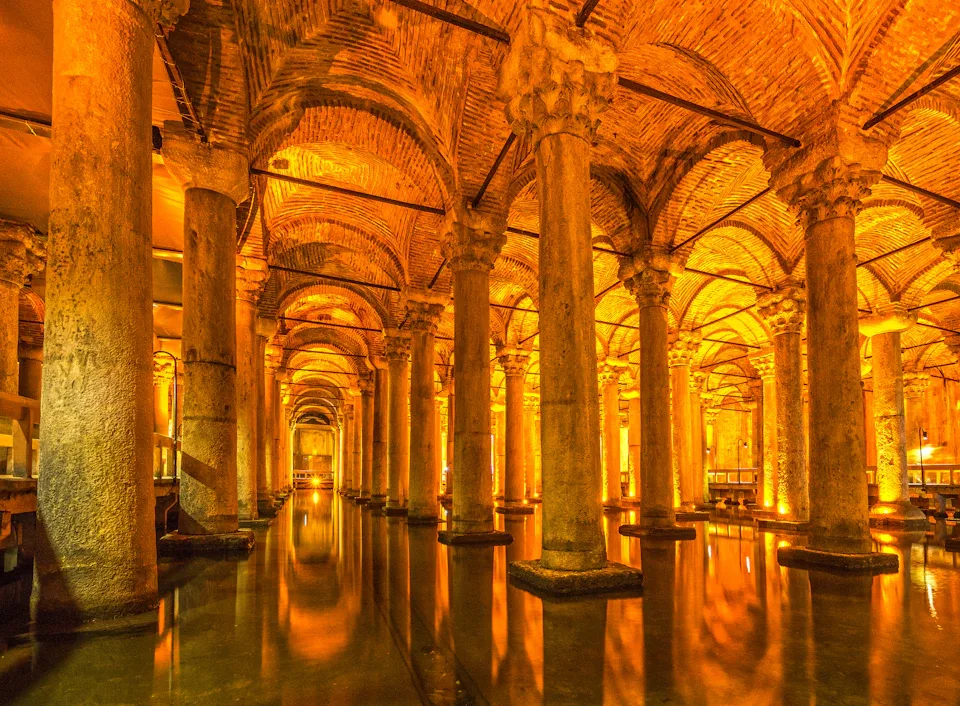
[ { "summary": "The Basilica Cistern is a brief but evocative underground experience focused on water reflections, rhythmic columns, and a moody contrast to the grand monuments above.
It is a destination for atmosphere rather than a long historical trek, making it ideal for photography enthusiasts and those who appreciate architectural texture.
Visitors on a tight budget or those who dislike cramped, dim spaces may find it less rewarding than other Sultanahmet landmarks.", "body": "• Essence: A short underground visit centered on water reflections, ancient columns, and a dramatic visual break from the city heat.\n• Price: Standard daytime entry is 1,950 TRY; prices for fixed-time slots or evening sessions are higher.\n• Time: Allocate 30–50 minutes for the visit; the route is compact and straightforward.\n• Booking: Purchasing tickets in advance is recommended to bypass the main ticket office queue and secure a specific entry window.\n• How to get there: The official entrance is at Yerebatan Cd.
1/3, Fatih.
Take the T1 Tram to the Sultanahmet stop and walk for about three minutes.\n• Common Mistake: Do not schedule this as a tight 15-minute gap between Hagia Sophia and the Blue Mosque; the entrance flow can be slow during peak hours.\n• Who it is for: Best for those seeking unique visuals and atmosphere; skippable if you prefer expansive museums or are sensitive to enclosed, dark environments.", "best_time": "The most tranquil experience is found during the first hour after opening or the final hour of the daytime session, when the crowd density is lowest.", "ticket_block": "If the Basilica Cistern is a priority for your Istanbul itinerary, book your ticket in advance.
For most independent travelers, the standard daytime entry is sufficient.
The walk is short and the path is easy to follow, with 30–50 minutes being plenty of time to see everything including the Medusa heads.\n\nPaying a premium is only logical in two scenarios: if you need a guaranteed time slot for a very tight schedule, or if you want to attend the evening session.
The price difference is significant, with daytime tickets at 1,950 TRY and evening sessions (from 19:30 to 22:00) at 3,000 TRY.
This extra cost is for the dramatic lighting and a more exclusive feel, not for a longer route.\n\nKey points to remember:\n• Basic daytime ticket: The best value for most visitors, especially if arriving early.\n• Fixed-time ticket: Useful for avoiding long lines during peak tourist hours.\n• Evening entry: Reserved for those prioritizing photography and a specific moody aesthetic.\n\nNote: The MuseumPass Istanbul is not valid here as the site is managed by the municipality, not the Ministry of Culture.
Children under 7 enter for free.", "timing_block": "Peak hours usually occur in the middle of the day when tour groups move between Hagia Sophia and the Blue Mosque. During these times, the walkways can feel crowded, making it difficult to capture clean photos without other visitors in the frame.
While the site remains impressive, the sense of 'underground silence' is lost in the crowd.\n\nA better strategy is to visit right at 09:00 or after 17:00. The lighting is more effective when the platforms are less packed, and the humidity feels less oppressive.
The site operates daily from 09:00 to 22:00, with the daytime session ending at 18:30 before the evening session begins at 19:30.\n\nFor solo travelers and couples, the early morning provides the best rhythm.
Families may find the early afternoon manageable, but be aware that the dim lighting and damp floors can be challenging for very young children if the site is overcrowded.", "editorial_note": "Treat the Basilica Cistern as a compact atmosphere stop rather than a full museum visit.
The 1,950 TRY daytime ticket is sufficient for most travelers; opt for the 3,000 TRY evening session only if dramatic lighting and quieter photography are your main priorities.\n\nThe experience is best for those who enjoy architectural textures and moody reflections.
If you are on a strict budget or uncomfortable in dim, enclosed spaces, you might find the short route underwhelming compared to the larger monuments nearby.\n\nPractical Tip: Wear comfortable shoes with good grip, as the metal walkways and stone stairs can become damp and slippery from the underground humidity." } ]

🎫 Tickets, tours & discounts
Basilica Cistern Daytime Entry Ticket
- Standard daytime admission to Basilica Cistern
- Self-guided underground visitor route
- Access to the Medusa head column bases
- Typical visit time of 30–50 minutes
Basilica Cistern Skip-the-Line Ticket with Audio Guide
- Skip-the-ticket-line entry channel
- Mobile ticket for Basilica Cistern
- Audio guide app for self-guided touring
- Access to the main cistern walkway and columns
Basilica Cistern Night Shift Ticket
- Evening admission to Basilica Cistern
- Night-time lighting inside the cistern
- Self-guided visit on the standard route
- Access to the Medusa head column bases
Hagia Sophia, Blue Mosque and Basilica Cistern Guided Tour
- Guided walking tour in Sultanahmet
- Entry to Basilica Cistern included
- Guided visit or orientation at Hagia Sophia
- Guided visit to the Blue Mosque when open
Which ticket to choose
For most travelers, the standard daytime entry is enough: the Basilica Cistern is a compact visit, and the main value is the atmosphere, reflections, columns, and Medusa heads rather than a long museum route. For foreign visitors, daytime entry is 1,950 TRY; an audio guide adds useful context if you like details but do not want a guided group.
Paying more makes sense if this stop is non-negotiable in your Sultanahmet plan, you are visiting during a busy midday window, or you want the evening “Night Shift” atmosphere. The evening session costs 3,000 TRY and runs after the daytime closure break, so it is not the budget choice.
- Basic daytime ticket: best value if you can arrive early or late in the regular visiting window.
- Ticket plus audio guide: good middle ground for independent travelers who want context.
- Timed or fast-track third-party ticket: useful when your schedule is tight, but it does not make the underground space less crowded.
- Evening entry: best for mood and lower heat outside, weakest for saving money.
Best time to go
Go in the first opening hours if you want the calmest experience and cleaner photos of the column rows. The cistern is underground, so sunset and golden hour do not improve the light inside; they mainly affect how crowded Sultanahmet feels before and after your visit.
Late daytime is also a good choice, especially if you are pairing it with Hagia Sophia, the Blue Mosque, or Topkapi Palace. Avoid placing it in a tight 30-minute gap between two major sights, because the entrance flow can easily eat into your schedule.
For solo travelers, early morning is the simplest choice. Families should aim for a calm daytime slot and allow 40–50 minutes with no rush. Photographers get the best results when the walkway is quieter, not when the outside light is prettier.
Combos and discounts
The Basilica Cistern pairs well with nearby Sultanahmet sights, but choose combos carefully. Bundles with Hagia Sophia, Topkapi Palace, or the Blue Mosque are only good value when they include a licensed guide, clear timed entry, or a route you already planned to do; do not pay extra for a “Blue Mosque ticket,” because mosque entry itself is free.
The Istanbul Museum Pass and MuzeKart do not cover the Basilica Cistern. Some Istanbul tourist passes and marketplace bundles include guided or fast-track Basilica Cistern access, but they are worth buying only if you will use several included attractions, not for this stop alone.
Children under 7 enter free. Discounted student pricing is for Turkish students and international students studying in Turkey, with ID required. Turkish citizens aged 65 and over have free entry during the daytime visitor session.
Advice: if you are paying at the entrance, use a credit card, debit card, or Istanbulkart. Cash is not accepted for museum entry.
When a tour makes sense
A guided tour adds value if you want the story behind the cistern rather than just the visuals: Byzantine water engineering, the Great Palace connection, reused Roman columns, the Medusa heads, and why this place feels so different from the monuments above ground.
It is also useful if you are combining the cistern with Hagia Sophia, Topkapi Palace, or the Hippodrome in one Old City walk.
Skip the tour if you mainly want photos, atmosphere, and a short cool break from Sultanahmet. The route is easy to follow on your own, and 30–50 minutes is enough for a satisfying self-visit.

Crowd indicator
Mini-calculator based on crowd levels by day and time.
This day is usually noticeably busy. This slot has a higher chance of a comfortable visit: fewer people and calmer pace.
Nearest days

How to get there
How to find the entrance
Go to the official entrance at Yerebatan Cd. 1/3, Fatih, in Sultanahmet. The nearest transit stop is Sultanahmet Tram, then it is a short walk through the busy historic core.
The confusing part is not the address itself, but the crowd flow around nearby landmarks. Hagia Sophia, the Blue Mosque, and the Basilica Cistern sit close together, so the pavement can feel crowded and slow even when the entrance is nearby.
Expect to lose extra time at the entrance queue, especially if you arrive between major sightseeing stops. A basic ticket starts from 900 TRY; a fixed-time ticket costs more but is the safer choice if the cistern is a must-see in your Sultanahmet route.

Practical limits & what to bring
What to consider before visiting
The Basilica Cistern is short but not friction-free: expect stairs at the entrance and exit, dim light, narrow walking platforms, crowding, and a humid underground atmosphere. Inside humidity is very high, water can drip from the ceiling, and the floor can feel slippery, so wear stable shoes and avoid thin heels.
There is no religious dress code here, unlike nearby mosques. Children under 15 must be accompanied by an adult, and the visit is not ideal for anyone uncomfortable with dark, enclosed, damp spaces.
What you can and cannot bring inside
- Food and drinks are not allowed inside the cistern.
- Suitcases, travel luggage, and baggage-style bags are not allowed for entry.
- Weapons, sharp tools, cutting items, and flammable/burning tools are forbidden.
- Smoking, including electronic cigarettes, is forbidden inside.
- Tripod photography and professional shoots require written permission and a paid arrangement.
- Costume or special-occasion photo shoots are not allowed.
- Casual photo and video on a phone or small camera is allowed if it does not disturb other visitors.
- Pets are accepted only in a carrier bag.
- Do not touch the columns, sculptures, artworks, water, or coins in the water; do not lean on or sit on the railings.
Luggage storage and belongings
Do not arrive with sightseeing luggage: the Basilica Cistern is not set up as a storage stop, and travel bags are refused at entry. Bring only what you can comfortably keep with you on the walking platforms — ideally a small day bag, phone, wallet, and a light layer if you are sensitive to damp interiors.
A stroller is a poor fit here because of the stairs, crowding, and narrow underground route. For babies or toddlers, a carrier is much easier than trying to manage wheels in the entrance flow and on the platforms.

Location and what's nearby
What kind of district
- Sultanahmet is Istanbul’s old-city museum core: dense, walkable, ceremonial, and packed with first-time visitors.
- The day here is about Byzantine and Ottoman monuments, courtyards, domes, mosaics, and short walks between major sights.
- Streets around Yerebatan Cd. feel busy and touristic, but the Basilica Cistern adds a rare quiet, low-light pause.
- It fits a culture-heavy half-day or full day; shopping and nightlife are better saved for Grand Bazaar, Karaköy, or Beyoğlu.
Nearby on foot (up to 15 minutes)
- Hagia Sophia — monumental dome, mosaics, and imperial scale · 3 min walk
- Sultanahmet Square — open historic axis between the great monuments · 4 min walk
- Blue Mosque — cascading domes, Iznik tiles, active mosque atmosphere · 6 min walk
- Turkish and Islamic Arts Museum — carpets, calligraphy, palace setting · 7 min walk
- Topkapi Palace — Ottoman courts, treasury rooms, Bosphorus views · 8 min walk
- Istanbul Archaeological Museums — ancient sculpture and the Alexander Sarcophagus · 10 min walk
- Gulhane Park — shaded garden break below palace walls · 10 min walk
- Arasta Bazaar — small covered market behind the Blue Mosque · 8 min walk
15–30 minutes by transport
- Grand Bazaar — historic covered shopping maze after the monument circuit · 15 min by tram
- Spice Bazaar — food gifts, spices, lokum, and Eminönü energy · 15 min by tram
- Suleymaniye Mosque — grand hilltop mosque with Golden Horn views · 15 min by taxi
- Galata Tower — skyline viewpoint after crossing toward Beyoğlu · 25 min by tram
- Karaköy — waterfront cafes and a livelier evening shift · 20 min by tram
Where to eat nearby
- Deraliye Restaurant — Ottoman palace cuisine · expensive · booking essential · 4 min walk
- Matbah Restaurant — historic Ottoman recipes · above average · advisable to book · 6 min walk
- Tarihi Sultanahmet Köftecisi Selim Usta — grilled köfte and piyaz · budget · walk in · 5 min walk
- Hocapaşa Pidecisi — wood-fired pide · budget · walk in · 12 min walk
- Şehzade Cağ Kebap — Erzurum-style lamb skewers · mid-range · walk in · 13 min walk
Ready-made day route
Start at Sultanahmet Square, visit Hagia Sophia and the Basilica Cistern, then continue to the Blue Mosque and Arasta Bazaar for a compact monument loop. For lunch, keep it simple at Tarihi Sultanahmet Köftecisi Selim Usta, then use the afternoon for Topkapi Palace or the Istanbul Archaeological Museums.
If you still have energy, finish with Gulhane Park before moving toward Eminönü or Karaköy for the evening.

ReferenceFacts
Read more
Numbers and Scale
- Size: 140 m by 70 m, giving 9,800 sq m of underground space beneath Sultanahmet.
- Capacity: 80,000 cubic meters of water, built to store a strategic reserve for the Great Palace area.
- Columns: 336 marble columns hold the vaults, arranged in 12 rows of 28 for a forest-like rhythm.
- Column height: 9 m, tall enough to make the chamber feel closer to a buried hall than a tank.
- Descent: 52 stone steps lead from street level into the cistern, making the temperature and light shift immediate.
- Restoration scale: 50,000 tons of mud were removed in the major modern cleanup, revealing the Medusa bases.
Myths and Misconceptions
- Myth: The Basilica Cistern was an underground church. Reality: Its name comes from the Stoa Basilica above, not worship inside.
- Myth: It was built by the Ottoman sultans. Reality: It is a sixth-century Byzantine reservoir associated with Emperor Justinian I.
- Myth: The Medusa heads were made for the cistern. Reality: They are reused Roman blocks, fitted as column bases.
- Myth: The upside-down Medusa position has one proven meaning. Reality: The exact reason is unknown; practical reuse is the strongest explanation.
- Myth: It is the only ancient cistern under Istanbul. Reality: It is the largest famous one, but Istanbul has hundreds of historic cisterns.
Rare and Unusual
- Spolia detail: Many columns and capitals were recycled from older Roman buildings, so the styles are deliberately uneven.
- Medusa corner: One Medusa head is upside down and the other is sideways, both tucked into the northwest end.
- Weeping Column: The carved “tears” and eye-like motifs make it one of the easiest columns to miss and regret missing.
- Rediscovery story: Petrus Gyllius explored the cistern by boat after hearing locals drew water and fish from basement holes.
- Old visitor route: Before modern walkways, parts of the cistern experience involved moving across the water by boat.
- Film cameo: The cistern appears in the James Bond film From Russia with Love, adding a spy-cinema layer to the site.
BackgroundHistory
Read more
The Basilica Cistern was built beneath the historic core of Constantinople to store and supply water for the imperial district. Its scale makes sense once you remember that this was not a decorative monument, but part of the city’s survival system: a hidden reservoir serving palaces, public buildings, and a crowded capital.
Why it still feels different
Unlike Hagia Sophia or the Blue Mosque, the cistern explains Byzantine Istanbul from below ground. The rows of reused columns, the shallow water, and the dim reflections turn a piece of infrastructure into one of Sultanahmet’s most atmospheric visits.
The Medusa-head column bases are the detail most visitors remember, but the larger point is the engineering: stone, water, and repetition creating a cool underground space that has lasted for centuries. For today’s visitor, the cistern is worth seeing because it gives a short, vivid contrast to the grand religious monuments above street level.

♿ Accessibility & families
Accessibility & Family Policy
- Wheelchair users: Basilica Cistern is mostly accessible after renovation. Use the staff-operated platform lift on the Alemdar Street side to reach the cistern level; inside, raised metal walkways cover the main visitor route, including the Medusa-head viewpoint. The space is dim, cool and damp, and the walkways can feel slippery, so a companion is useful for manual wheelchair users.
- Strollers: Strollers are a hassle here rather than a comfort. The main route uses stairs, the accessible lift is staff-operated, and the underground walkways get tight in peak hours; a baby carrier is the better choice for toddlers and babies.
- Children and tickets: Children who have not yet turned 7 enter free when visiting with family. No general minimum age is set for standard daytime visits, but young children need close supervision because of the low lighting, water below the walkways, railings, crowds and echoing noise.
- Reduced-mobility visitors: The visit is short and visually impressive, but it is underground, humid and often crowded. Plan on 30–45 minutes inside; the least comfortable parts are the entrance queue, stairs for anyone not using the lift, and bottlenecks around the Medusa columns. The nearest tram stop is Sultanahmet on the T1 Kabataş–Bağcılar line, a short walk from the entrance at Yerebatan Caddesi 1/3, Fatih.
🏢 On-site amenities
On-site amenities
- Restrooms: There are no toilets in the underground cistern viewing route. The restroom area is at street/ground level near the entrance/exit; use it before going down or after coming back up.
- Food and drink: There is no proper café or restaurant inside the main experience zone. Food and drinks are not allowed in the cistern, but bottled water is accepted. There is no confirmed drinking-water fountain inside.
- Gift shop: There is a small souvenir shop at the exit. It mainly sells Basilica Cistern and Medusa-themed souvenirs, small gifts, cups, postcards, and books.
- Connectivity and family facilities: Do not rely on mobile signal or internet once underground. No dedicated nursing room, baby-changing room, or prayer room is confirmed on-site.
