Hagia Sophia

Hagia Sophia

Why visit

Who will love it
Best forFirst-time visitors staying in or around Sultanahmet who want the clearest single introduction to imperial Istanbul. Prioritize Hagia Sophia if you are happy to spend about 1,300 TRY for the visitor route, can handle airport-style security and mosque etiquette, and want a high-impact stop that still fits into 1–1.5 hours; the easiest approach is the T1 tram to Sultanahmet, then a short walk across the square.
Who should skip it

You can lower it on your list if you have already seen the interior before, are keeping a very tight budget, or want a quiet, museum-style visit with unrestricted movement and long, unhurried viewing.

It is still one of the city’s defining sights, but for the best experience treat it as an essential first-visit landmark, not a slow deep-dive stop, and go early on a weekday or later in the day when the square is less congested.

What to know beforehand

{ "summary": "Hagia Sophia is a destination for those seeking a rare sense of scale rather than a lengthy museum itinerary. In a single visit, you can grasp the Byzantine volume, the Ottoman layers, and the historical logic of Istanbul’s center.

It is best suited for first-time visitors who want to experience the city's imperial character efficiently.

The primary trade-off is its status as a working mosque: during peak hours and prayer times, the space is crowded and noisy, making it less ideal for quiet contemplation.", "body": "- The Essence — Hagia Sophia provides a massive Byzantine cathedral volume wrapped in Ottoman history, offering the definitive imperial Istanbul feeling in one visit.\n- The Price — Foreign tourists use a dedicated paid entrance (approximately 900 TRY) for the upper gallery; the ground floor is reserved for worship.\n- Best Timing — Arrive early on a weekday morning or late in the afternoon; allow 1 to 1.5 hours for a steady walkthrough.\n- How to Get There — Take the T1 tram to Sultanahmet station; the building is visible immediately, and the entrance is managed through security checkpoints on the square.\n- The Main Nuance — As a functioning mosque, visitor flow and access logic change during prayer times, often leading to increased noise and tighter crowds.\n- Common Mistake — Do not join the first line you see; look for the specific tourist queue tail on the square before passing through security.\n- What to Consider — A modest dress code is mandatory; shoes must be removed at the entrance, and large backpacks or bulky strollers will significantly slow you down at security.", "best_time": "Early morning on weekdays or late afternoon after the main tour groups have left.", "ticket_block": "### Which Ticket to Choose\n\nFor a standard visit, the tourist entry ticket is the only requirement.

It leads you through a specific route to the upper gallery, which offers the best perspective on the dome’s scale, the surviving mosaics, and the overall interior volume.

For a typical walk through Sultanahmet, this is sufficient; a premium option is rarely necessary unless you specifically want a digital experience or a private guide.\n\nPaying for a guided tour makes sense if you want deep context on the transition from a church to a mosque or the specific symbolism of the mosaics.

However, a fast-track ticket does not bypass security; the primary bottleneck is the mandatory X-ray screening and the physical flow of people, not the ticket window itself.\n\n- Standard Tourist Ticket: Best for seeing the architecture and mosaics from the gallery level.\n- Ticket with Audio Guide: Recommended if you prefer a self-paced visit with historical context.\n- Guided Tour: Worthwhile if history is as important to you as the architecture itself.\n\nImportant: The ground floor prayer area is generally closed to tourists.

The current visitor experience is centered on the gallery level, which provides the most iconic views of the interior.\n\n### When to Visit\n\nThe most comfortable strategy is arriving right at the opening of tourist hours or waiting until the late afternoon.

During these windows, the security line moves faster, the gallery is less congested, and you can observe the mosaics without being constantly pushed by the crowd.\n\nMidday is the least favorable time: the square becomes packed, large tour groups dominate the interior, and on Fridays, the schedule is interrupted by the midday prayer.

While the sunset light on the exterior is beautiful, the interior route is fixed, so an early morning visit is much more practical for avoiding the heat and the noise.\n\n### Combos and Discounts\n\nCombos are useful if you plan to visit the Topkapi Palace and the Archaeological Museums on the same day, as they sit in the same historical cluster.

If Hagia Sophia is your only goal in Sultanahmet, a single ticket is the most logical choice.

Note that city passes often provide a digital code or a pre-paid entry, but everyone must still clear the same security line.\n\n### When a Tour is Worth It\n\nA tour adds value if you want to understand how Justinian’s masterpiece was adapted by the Ottomans.

A professional guide will point out subtle details in the gallery that are easily missed and can explain the complex logistics of the building's current status.

If you just want to see the big picture and the famous dome, a solo visit is perfectly fine.", "prime_timing_block": "The heaviest visitor traffic occurs between 11:00 and 15:00 when organized excursion groups arrive.

During this window, the density inside the gallery and on Sultanahmet Square makes it difficult to appreciate the architectural scale.

To avoid the longest queues, aim for the first hour of operation or the period after 16:00.\n\nYour timing dictates the atmosphere: mornings offer a calmer pace and better light for interior photos, while late afternoon visits benefit from shorter lines.

Remember that as a working mosque, the schedule is anchored to prayer times, which may cause brief shifts in how visitors are managed.\n\nAdvice: Avoid visiting on Friday mornings.

The large congregational prayer creates significant crowds and the tourist entrance may be restricted or delayed, leading to massive backlogs immediately afterward.", "editorial_note": "Hagia Sophia works best as a focused architectural stop rather than a traditional museum.

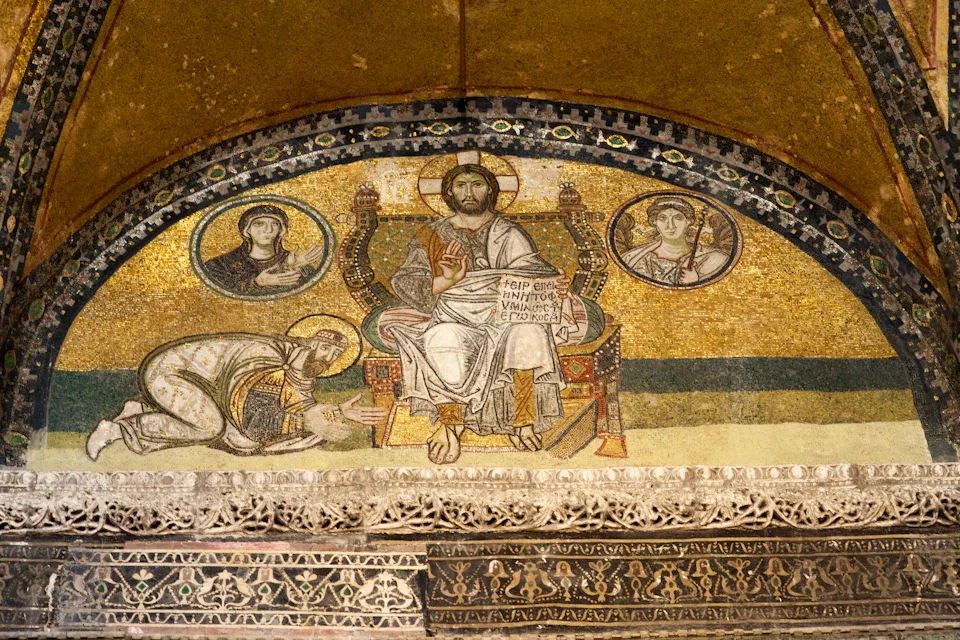
Since the visitor route is now restricted to the upper gallery, the experience is defined by the view from above—looking down into the prayer hall and getting close to the Byzantine mosaics.

It is a high-impact, one-way journey that rewards those who appreciate scale and historical layers over those seeking a quiet, meditative space.\n\nThis visit is a must for first-time Istanbul travelers, but it may underwhelm those who expect full access to the ground floor or a slow, room-by-room exploration.

The primary challenge is the crowd density; if you are sensitive to tight spaces or long security lines, the experience can feel more like a logistical hurdle than a spiritual one.\n\nPractical Insight: Wear thick socks.

Since you must remove your shoes before entering the carpeted areas, the floor can feel cold, and having socks makes the transition much more comfortable." }

Framed upward view of Hagia Sophia dome between stone columns and glowing chandelier

🎫 Tickets, tours & discounts

[ { "### Which ticket to pick": "For most visitors, the standard entry ticket to the visitor gallery is the only requirement. It costs approximately 850 TRY and provides access to the upper floor, where you can view the famous Byzantine mosaics and the vast interior from an elevated perspective.

The ground floor is reserved for worship, so a separate ticket for the 'tourist' section is the standard way to experience the monument's scale and history.\n\nAvoid buying 'fast-track' offers from unofficial guides outside the entrance. There is no special VIP entrance that bypasses the mandatory security screening.

A common mistake is assuming the ground floor is open to all; currently, the visitor ticket specifically covers the gallery level, which offers the best views for photography and historical study.", "### Best time to visit": "The best time to arrive is at 09:00 on a weekday to stay ahead of the large tour groups that typically arrive by mid-morning.

Alternatively, visiting about an hour and a half before the final entry time in the evening offers a much calmer atmosphere and softer lighting for photos. \n\nAvoid visiting on Fridays before 15:00.

As an active mosque, Hagia Sophia experiences heavy crowds during the Friday noon prayer, and tourist access may be restricted or significantly more crowded during this period.

For photographers, the late afternoon 'golden hour' provides the most dramatic light through the gallery windows, highlighting the gold in the mosaics.", "### Combos and discounts": "While Hagia Sophia itself has a fixed entry fee for foreign tourists, you can save by purchasing the Museum Pass Istanbul if you plan to visit Topkapi Palace and the Archaeological Museums within five days.

Another practical option is the 'Hagia Sophia History Museum' combo, which includes a digital immersive show located in the nearby Ibrahim Pasha Palace.

This digital experience provides the historical context that is sometimes hard to grasp inside the mosque itself.\n\nChildren under the age of 8 generally enter for free, provided you have a valid passport to prove their age at the ticket booth.

There are no specific 'off-peak' discounts, but buying a combined ticket for the digital museum and the monument usually results in a lower total price than buying them separately.", "### When a tour makes sense": "A guided tour is highly recommended if you want to distinguish between the original 6th-century Byzantine elements and the later Ottoman additions.

Without a guide, it is easy to miss subtle details like the Viking graffiti on the gallery railings or the specific symbolism behind the placement of the mosaics. \n\nIf you prefer a self-guided experience, the official QR-code audio guide available at the entrance is sufficient.

However, a professional guide is invaluable for navigating the complex entry logic and explaining the transition of the building from a cathedral to a mosque.

Solo travelers who just want to admire the architecture can easily skip the tour, but history enthusiasts will find the extra cost worth the context.", "Important:": "Ensure you are dressed modestly: shoulders and knees must be covered, and women must wear a headscarf to enter.

If you do not have one, disposable scarves and wraps are available for purchase at the entrance. You will also be required to remove your shoes before entering carpeted areas." } ]

View tickets

Hagia Sophia interior with hanging chandeliers and giant calligraphy medallions
Weather now
Istanbul, Republic of Türkiye
NowMostly clear 🌤️
Temperature24°C
VisibilityExcellent
AerosolsClean air · AOD 0.12

Good conditions for visiting today.

AOD — how much dust and haze in the air dim the distant view. 0 clean, >0.4 noticeable, >0.7 heavy.

Crowd indicator

Mini-calculator based on crowd levels by day and time.

When to go?

Mini-calculator based on crowd levels by day and time.

Best time at Mon — 18:00

This day has average visitor density. This slot has a higher chance of a comfortable visit: compromise between light and visitor flow.

30–50% · Quiet60–80% · Moderate90–100% · Crowded

Nearest days

Today
10:0075%
12:0085%
14:0080%
16:0070%
17:0075%
18:0045%
Tomorrow
10:0075%
12:0085%
14:0080%
16:0070%
17:0075%
18:0045%
Day after tomorrow
10:0080%
12:0090%
14:0085%
16:0075%
17:0080%
18:0050%
Exterior of Hagia Sophia with domes and minarets under blue sky

How to get there

Nearest stationSultanahmet Tram

How to find the entrance

1
Start at SultanahmetExit the T1 tram at Sultanahmet and head into Sultanahmet Square; Hagia Sophia is directly visible
2
Find the queue endWalk along the line first and join at the back instead of entering from the nearest side
3
Pass security checkStay in the visitor flow and allow extra time for the mandatory bag and entry screening
4
Enter mosque areaAfter security, continue with the marked visitor stream; wear modest clothing and be ready to remove your shoes

From the T1 Sultanahmet tram stop, Hagia Sophia is visible across the square, so the hard part is not finding the building; it is finding the correct line. Do not join the first crowd you see. Walk to the square side of Hagia Sophia, find the end of the visitor queue, then continue toward security.

ImportantTourist entry and prayer access are not the same. Foreign visitors use the paid Visiting Area route, with a €25 ticket charged by card or in its TRY equivalent; worshippers are directed separately. The tourist route takes you through security and into the upper gallery, not onto the main prayer floor.

Expect to lose time in three places: the ticket line, security screening, and the moving queue near prayer times. Keep shoulders and knees covered, women should have a head covering ready, and avoid large backpacks because they slow down inspection.

Shoes are removed only where the mosque route requires it, so wear something easy to take off and carry. A bulky stroller is awkward here: the approach, crowds, and controlled movement make it much easier with a foldable stroller or baby carrier.

Roped marble omphalion area inside Hagia Sophia with visitors beyond

Practical limits & what to bring

What to consider before visiting

Hagia Sophia is an active mosque and a controlled heritage site, not a free-flow museum. Expect a live queue on Sultanahmet Square, airport-style security screening, and a one-way visitor route with bottlenecks at the entrance, ramps, gallery sections, and shoe-removal points.

Dress modestly: shoulders and knees covered, no revealing tops, and a head covering for women. Wear socks and easy slip-on shoes, because shoes must come off before carpeted mosque areas. There is no special age limit, but the visit is harder with toddlers during peak crowding; a baby carrier is more practical than a bulky stroller.

The tourist route is mainly the upper gallery, while the main prayer floor is reserved for worship. Allow 1-1.5 hours, with extra patience in hot weather because much of the slow part is outside or in crowded transition areas.

ImportantDo not arrive with a rigid sightseeing schedule. Security, prayer-time adjustments, and crowd control can slow the visit even when the building is open.

What you can and cannot bring

  • Allowed: small day backpack or handbag.
  • Allowed: phone, compact camera, and standard personal camera without flash.
  • Allowed: small closed water bottle carried in your bag; do not eat or drink inside the mosque space.
  • Allowed: scarf or shawl for covering hair and shoulders.
  • Not allowed: large backpacks, suitcases, and wheeled luggage.
  • Not allowed: food for eating inside.
  • Not allowed: tripods and commercial filming equipment without permission.
  • Not allowed: flash photography.
  • Not allowed: pets, except assistance animals.

Storage and belongings

There is no visitor cloakroom or luggage locker inside Hagia Sophia for suitcases or oversized bags, so arrive with only what you can carry through security and keep with you. Shoes are handled separately: use the provided shoe bag or the shoe area where instructed, but do not treat it as general storage.

Large strollers are uncomfortable on the route because of queues, ramps, crowd flow, and limited space near control points. A compact folding stroller is easier to manage, but for a smoother visit with a small child, use a carrier and keep both hands free.

Chandeliers and calligraphy medallions inside Hagia Sophia under sunbeams

Location and what's nearby

What kind of neighborhood

  • Sultanahmet is Istanbul’s old imperial core: dense, monumental, walkable, and built for a culture-heavy first day.
  • The mood is busy by day and calmer after dinner, with tour groups, families, school groups, and first-time visitors sharing the same squares.
  • It suits a compact old-town route better than nightlife or shopping; the best use of time is chaining major monuments on foot.
  • Expect high tourist pressure around the main square, but quieter pockets appear on Soğukçeşme Street, Gülhane Park, and side lanes toward Cankurtaran.

Within 15 minutes on foot

  • Sultanahmet Square — open historic plaza between the city’s headline monuments · 2 min
  • Basilica Cistern — atmospheric underground reservoir with Medusa-head columns · 3 min
  • Blue Mosque — grand Ottoman mosque facing Hagia Sophia across the square · 4 min
  • Hippodrome of Constantinople — ancient racecourse spine with obelisks and monuments · 5 min
  • Topkapi Palace — sultans’ palace complex with courtyards and Bosphorus views · 7 min
  • Istanbul Archaeological Museums — strong collection for Byzantine and classical context · 9 min
  • Gülhane Park — shaded former palace garden for a quieter pause · 10 min
  • Arasta Bazaar — small historic market street behind the Blue Mosque · 7 min

15–30 minutes by transport

  • Grand Bazaar — covered market maze that extends the old-city theme · 15 min by tram
  • Spice Bazaar — compact food-and-spice market near Eminönü waterfront · 15 min by tram
  • Süleymaniye Mosque — calmer imperial mosque with Golden Horn views · 20 min by taxi
  • Galata Tower — hilltop viewpoint pairing well with old-city panoramas · 25 min by taxi
  • Karaköy — waterfront cafes and galleries after the monument circuit · 20 min by tram

Where to eat nearby

  • Matbah — Michelin-listed Ottoman palace cuisine · expensive · booking essential · 3 min walk
  • Tarihi Sultanahmet Köftecisi Selim Usta — grilled köfte and piyaz · budget · no reservation needed · 6 min walk
  • Seven Hills Restaurant — rooftop seafood and Hagia Sophia views · expensive · booking essential · 4 min walk
  • Deraliye Ottoman Cuisine — Ottoman classics near Sultanahmet Square · above average · advisable to book · 5 min walk
  • Caferaga Medresesi Tea Garden — tea and simple courtyard snacks · budget · no reservation needed · 2 min walk

Ready-made day route

Start at Sultanahmet Square, visit Hagia Sophia, then cross to the Basilica Cistern before moving on to the Blue Mosque and Hippodrome. Continue to Topkapi Palace or Gülhane Park, depending on how much museum time you want, then stop for lunch at Tarihi Sultanahmet Köftecisi Selim Usta or make dinner the scenic part of the day at Seven Hills Restaurant.

NoteDo the big indoor sights before lingering in the square; the open areas are easier to enjoy once the heaviest daytime groups have moved on.
Minbar and calligraphy medallions inside Hagia Sophia
Reference

Facts

Read more

Verified Numbers and Scale

  • Construction: Built from 532 to 537, a 6th-century project speed that still feels startling for a structure of this size.
  • Dome height: 55.6 m above the floor, which is why the main hall feels vertical before it feels wide.
  • Dome diameter: 31.24 m, carried by pendentives rather than a simple circular drum.
  • Footprint: 82 m long and 73 m wide, giving first-time visitors a clear sense of imperial Istanbul in one interior.
  • Dome windows: 40 windows ring the base of the dome, creating the famous floating-light effect above the nave.
  • Calligraphy scale: The main round medallions are 7.5 m across, large enough to read from the floor without binoculars.
  • Minarets: 4 minarets mark the Ottoman phase, so the exterior reads as both Byzantine mass and imperial mosque.

Myths and Misconceptions

  • Myth: Hagia Sophia is named after Saint Sophia. In reality: The name means Holy Wisdom, not a female saint.
  • Myth: Sinan designed Hagia Sophia. In reality: Anthemius of Tralles and Isidore of Miletus designed the 6th-century building.
  • Myth: The Blue Mosque is older. In reality: Hagia Sophia was completed in 537; the Blue Mosque came over a millennium later.
  • Myth: The Ottoman conversion destroyed all mosaics. In reality: Many mosaics were covered, not destroyed, and several survive.
  • Myth: It was always only a church or mosque. In reality: It also functioned as a museum between its religious phases.

Rare and Unusual

  • Omphalion: The patterned marble circle near the southeast side marked Byzantine imperial ceremonies, not just decoration.
  • Wishing Column: The bronze-covered column with a thumb hole is tied to a centuries-old healing and blessing tradition.
  • Viking trace: A runic inscription linked to the name Halfdan survives in the upper gallery, scratched into the marble.
  • Off-axis prayer focus: The mihrab sits slightly angled because Mecca does not align with the building’s original eastward axis.
  • Fossati layer: Swiss-Italian restorers documented hidden mosaics in the 19th century before some were covered again.
  • Imperial Door: The largest western inner door was reserved for the emperor, turning arrival into a controlled political ritual.
Background

History

Read more

Why it matters

Ayasofya matters because it is not just an old monument; it is the clearest single place to read Istanbul’s imperial past. It began as the great cathedral of Constantinople, built to project the power, faith, and ceremony of the Byzantine capital on a scale that still feels overwhelming inside.

After the Ottoman conquest, it was turned into a mosque rather than erased, which is why the building carries both worlds at once. The vast dome and Byzantine structure remain the core experience, while minarets, calligraphic roundels, the mihrab, and other Ottoman additions show how the city’s second empire made the monument its own.

For today’s visitor, that layered history is the point of the visit. In one stop, you see why Sultanahmet is the symbolic center of Istanbul: Ayasofya is where Byzantine and Ottoman history meet in the same space, and that mix is what makes the interior feel unlike anywhere else in the city.

Crowd entering Hagia Sophia courtyard with sunlit walls and tall minaret

♿ Accessibility & families

Accessibility & family policy

  • Wheelchair users and reduced-mobility visitors: Hagia Sophia is not an easy-access monument. The standard tourist route runs through the upper visiting area and uses long ramps and some stairs, with no simple lift-based route to the main visitor circuit. In practice, this is a difficult visit for wheelchair users and for anyone who struggles with slopes, uneven historic flooring, or standing for long periods.
  • Strollers: Strollers are allowed only if folded and carried inside the visiting area. You cannot roll a stroller through the full visitor route, so a baby carrier is far more practical for infants and toddlers.
  • Children and family entry: Children under 8 enter free when accompanied by an adult and with a valid passport or ID. There is no published minimum age for entry, and families with children can visit.
  • What families should expect: This is a calm family visit if you come outside the busiest hours, but the interior can feel tight, noisy, and slow-moving when queues build up. The main family friction points are the security line, dense crowds, long standing time, and the need to carry a folded stroller. For children under 12, it works best as a short visit rather than a long museum-style stop.

🏢 On-site amenities

  • Restrooms: There are no toilets on the upper-gallery visitor route, which is the main experience for ticketed visitors. The route is essentially an entrance ramp, the gallery circuit, and the exit ramp.
  • Cafe / restaurant: There is no cafe or restaurant inside Hagia Sophia itself. This is a monument-and-mosque visit, not a sit-down attraction with indoor food service.
  • Gift shop: There is no souvenir shop on the current visitor route. At the ticket area, you can get basic dress-code items such as a headscarf or body cover if needed for entry.
  • Water: The wider complex includes fountains for ablutions, but there is no drinking fountain on the visitor route. If you want water during your visit, bring a small bottle and finish it before entering the prayer-sensitive indoor areas.
  • Families and prayer: There is no separate nursing room or baby-changing facility in the visitor area. Strollers must be folded and carried inside. For prayer, Hagia Sophia itself is the facility: the ground floor is the worship area, entered separately from the main square, while visitors follow the upper-gallery route.

Reliability & freshness

PublishedApril 7, 2026
UpdatedMay 29, 2026

I live in Istanbul and, after seven years here, I write clear guides on getting around Türkiye day to day.